Sponsorship Opportunity: Full Sponsorship: $290,700*
History & Preservation
Altar of San Giuseppe da Copertino and Alessandro Vittoria’s Sculptures in the Basilica of Santa Maria Gloriosa dei Frari
Alessandro Vittoria (1525 – 1608); Giuseppe Nogari (1699-1763) | Church of Santa Maria Gloriosa dei Frari
Full Sponsorship: $290,700*
Full Sponsorship: $290,700*
Sponsorship Opportunity
Save Venice is seeking sponsors for the conservation of the Altar of San Giuseppe da Copertino and Alessandro Vittoria’s Sculptures, and for the Conservation Maintenance of Giuseppe Nogari’s Altarpiece.
*Published sponsorship costs are subject to change due to conservation plan modifications and fluctuations in exchange rates.
Please contact kim@savevenice.org today for more information and the latest cost estimates.
History
The altar of San Giuseppe da Copertino was originally commissioned from the sculptor Alessandro Vittoria by Gerolamo Zane, one of the most influential figures of the Venetian patriciate, who selected the Basilica dei Frari as his burial place on 11 December 1562. A distinguished diplomat and statesman, Zane served as Ambassador to Constantinople, Procurator of San Marco, and Captain-General of the Venetian Fleet, and was honoured with a knighthood by Pope Pius IV. The altar still preserves two carved shields bearing the rampant dog of the Zane family, a heraldic emblem of their lineage. Originally, the family’s presence was even more prominently asserted through two large coats of arms incorporated into the fictive architectural framework frescoed on the upper register, now lost.
Widely regarded as Vittoria’s masterpiece in stucco, the Zane altar was partially dismantled in 1753 to accommodate an altarpiece by the Venetian painter Giuseppe Nogari depicting The Ecstasy of San Giuseppe da Copertino. Installed to honor the newly celebrated Franciscan saint, the canvas is considered one of Nogari’s finest works, demonstrating his mastery of luminous color, soft atmospheric effects, and expressive narrative. Yet the painting’s installation came at a significant cost. In order to make room for the altarpiece, a substantial portion of Vittoria’s original sculptural program was removed. What survives today—a marble figure of Saint Jerome flanked by stucco statues of Saint Peter (left) and Saint Andrew (right), set within a two-tiered altar frame crowned by a pair of stucco sibyls—represents only a fragment of Vittoria’s original and far more ambitious conception.

The Altar of San Giuseppe da Copertino, before conservation (Photo: Matteo De Fina).
Recent research has shown that Nogari’s painting replaced a monumental high-relief stucco altarpiece depicting the Assumption of the Virgin. Giorgio Vasari, who knew Vittoria personally, records that the composition was dominated by an Assunta, likely conceived in dialogue with Titian’s celebrated altarpiece for the Frari (restored by Save Venice). Around the freestanding marble figure of Saint Jerome, a dense assembly of saints—including Peter, Andrew, Leonard, and John the Baptist—formed a richly layered sculptural ensemble that seamlessly integrated architecture, relief, and statuary. Although the original work was destroyed in the 18th century, Vittoria’s Assunta, carved for the Altar of Saint Jerome in the Scuola di San Fantin in the mid-1580s and now preserved in the Basilica of Santi Giovanni e Paolo, offers a valuable point of comparison. It provides a suggestive indication of both the visual impact and the compositional character of the lost Frari altarpiece.

Vittoria’s Saint Jerome—patron saint and namesake of Gerolamo Zane—warrants closer attention. Contemporary sources record that the sculptor carved the figure from a “large and very beautiful block of marble” supplied by his patron. They also reveal something of Vittoria’s creative process: during a visit to the artist’s workshop, the Florentine humanist Cosimo Bartoli saw a series of preparatory models for the statue, which he subsequently described in a letter to Giorgio Vasari dated 23 August 1566. The sculpture likewise testifies to Vittoria’s engagement with the art of Michelangelo, who had died in 1564, shortly before work on the altar began. The saint’s flowing beard, with its deeply carved strands, recalls Michelangelo’s Moses, while the idealized anatomy and powerful sense of terribilità evoke the Florentine master’s sculptural language more broadly. A similar debt has been identified in the two reclining sibyls that crown the altar and hold tablets bearing Vittoria’s signature. Their poses have long been associated with Michelangelo’s Times of the Day in the Medici Chapel (c. 1525–30), suggesting that the Frari monument was conceived, at least in part, as a tribute to the artist whose influence continued to shape Italian sculpture in the decades following his death.
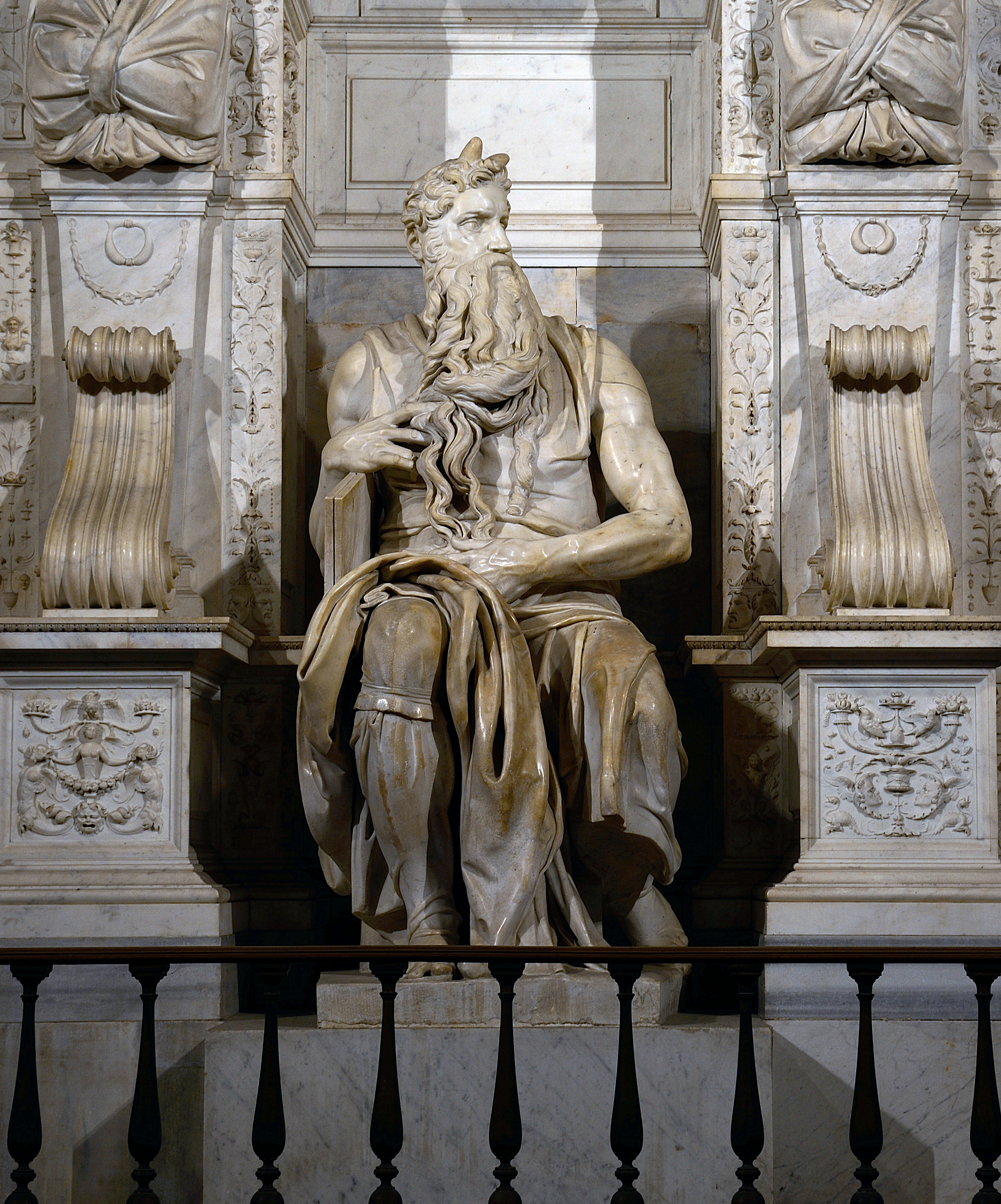

Alessandro Vittoria's "Saint Jerome," before conservation (Photo: Matteo De Fina).
The dating of the frescoes, which—like many decorative schemes in the Frari—visually extend the architectural framework of the altar, remains a matter of scholarly debate. Some scholars regard them as later additions that replaced Vittoria’s original stucco extensions, while others argue that they were introduced in 1753 to integrate the lateral niches after the stucco figures of Saints Peter and Andrew had been relocated. A third hypothesis maintains that the frescoes are contemporary with Vittoria’s altar and should be attributed to an as-yet unidentified artist active in the mid-16th century. Scientific examination of the frescoes may help clarify their chronology and resolve one of the most contested aspects of the monument’s history.
Conservation
The altar suffers from significant deterioration caused by rising damp, particularly in its lower sections. Prolonged exposure to moisture has weakened both the stone and stucco elements, resulting in surface erosion, flaking, loss of material, and areas of structural instability. The condition of the feet of Saint Peter and of the decorative corbels supporting the lateral niches is especially concerning, as portions of the original material have progressively crumbled away. The surrounding fresco decoration has also been affected by water infiltration and runoff, causing widespread wear and loss of definition. Conservation treatment will focus on stabilizing fragile areas, consolidating weakened materials, cleaning surfaces, and repairing losses where necessary to halt further deterioration and restore the monument’s legibility.
Giuseppe Nogari’s The Ecstasy of San Giuseppe da Copertino requires only conservation maintenance. Careful cleaning will recover the altarpiece’s tonal balance and chromatic clarity, while ensuring its long-term preservation.

Detail of Vittoria's stucco decoration and adjacent frescoes showing surface erosion, flaking, and material loss, before conservation (photo: Matteo De Fina).

Detail of Vittoria's "Saint Peter" highlighting structural instability, surface erosion, and flaking, before conservation (photo: Matteo De Fina).

The right plinth before conservation treatment, showing weakened stone with associated material loss and surface flaking (photo: Matteo De Fina).
About the Artworks
Alessandro Vittoria (1525 – 1608)
Altar of San Giuseppe da Copertino (Zane Altar)
1566 – ca. 1577-1579, marble, stucco, frescoes
700 x 950 cm
Giuseppe Nogari (1699-1763)
The Ecstasy of San Giuseppe da Copertino
1753, Oil On Canvas
277 X 540 cm
For Further Reading
Avery, Victoria. Alessandro Vittoria: the Michelangelo of Venice? In Ames-Lewis, Francis and Paul Joannides (eds.). Reactions to the Master: Michelangeloʼs Effect on Art and Artists in the Sixteenth Century. Aldershot: Ashgate, 2003, pp. 157-179
Avery, Victoria. “Belo et onorato per onor ancho suo:” Alessandro Vittoria’s Zane Altar Reconsidered. In Corsato, Carlo and Deborah Howard (eds.). Santa Maria Gloriosa dei Frari. Im magini di Devozione, Spazi della Fede. Padua: Centro Studi Antoniani, 2015, pp. 233-249
Cessi, Francesco. Alessandro Vittoria architetto e stuccatore (1525-1608). Trent: Manfredi Edizioni, 1961
Finocchi Ghersi, Lorenzo. Alessandro Vittoria. Architettura, scultura e decorazione nella Venezia del tardo Rinascimento. Udine: Forum, 1998
Leithe-Jasper, Manfred. Alessandro Vittoria e la scultura del suo tempo a Venezia. In Bacchi, Andrea, Lia Camerlengo, and Manfred Leithe-Jasper (eds.).“La bellissima maniera.” Alessandro Vittoria e la scultura veneta del Cinquecento. Trento: Provincia Autonoma di Trento, 1999, pp. 15-45
In Progress
Church of Santa Maria Gloriosa dei Frari
Giovanni Bellini’s Madonna and Child with Saints (Frari Triptych) and Frame in the Basilica dei Frari
Giovanni Bellini (ca. 1424/30 – 1516); Jacopo da Faenza
Completed
Church of Santa Maria Gloriosa dei Frari
Funerary Monument to Doge Francesco Foscari at the Basilica dei Frari
Niccolò di Giovanni Fiorentino (c. 1418 – c. 1506) [attr.]
Completed
Church of Santa Maria Gloriosa dei Frari
Titian’s Assumption of the Virgin in the Basilica dei Frari
Titian (c. 1488/90-1576) (Altarpiece), Giovanni Battista Bregno (?-1523) and Lorenzo Bregno (1475/85-1525) (Frame)
Complete
Church of Santa Maria Gloriosa dei Frari
Titian’s Madonna di Ca’ Pesaro Altarpiece in the Basilica dei Frari
Titian (Tiziano Vecellio) (c. 1488/90 – 1576)
Complete
Church of Santa Maria Gloriosa dei Frari
Giuseppe Porta Salviati’s Purification of the Virgin at the Basilica dei Frari
Giuseppe Porta, called Giuseppe Salviati (c. 1520–1575)
Completed
Church of Santa Maria Gloriosa dei Frari
Donatello’s Saint John the Baptist at Santa Maria Gloriosa dei Frari
Donatello (c. 1386–1466)
Completed
Church of Santa Maria Gloriosa dei Frari
Donatello’s Saint John the Baptist and the Fiorentini Altar in the Basilica dei Frari
Donatello (c. 1386–1466); 16th-century Venetian woodcarver
Complete
Church of Santa Maria Gloriosa dei Frari
Funerary Monument of Jacopo Pesaro at Santa Maria Gloriosa dei Frari
Unidentified sculptor
Complete
Church of Santa Maria Gloriosa dei Frari
Funerary Monument of Melchiorre Trevisan at Santa Maria Gloriosa dei Frari
Unidentified sculptor
Complete
Church of Santa Maria Gloriosa dei Frari
Paolo Veneziano’s Votive Picture of Doge Francesco Dandolo at the Basilica dei Frari
Paolo Veneziano (c. 1300 - c. 1362)
Completed
Church of Santa Maria Gloriosa dei Frari
Shutters of the Sacristy Clock at Santa Maria Gloriosa dei Frari
Unidentified artist (17th century)
Complete
Church of Santa Maria Gloriosa dei Frari
Tomb Monument of Count Alvise Della Torre in the Basilica dei Frari
Unidentified artist
Complete
Church of Santa Maria Gloriosa dei Frari
Tomb of the Contarini Family at Santa Maria Gloriosa dei Frari
Unidentified artist
Complete
Church of Santa Maria Gloriosa dei Frari
Baldassare Longhena and Juste Le Court’s Funerary Monument of Almerico d’Este at the Basilica dei Frari
Baldassare Longhena (1598–1682) and Juste Le Court (1627–1679) [attr.]
Explore other projects in San Polo
News & Stories
New York Office
133 East 58th Street, Suite 501
New York, NY 10022
Venice Office
Palazzo Contarini Polignac
Dorsoduro 870 30123 Venice, Italy
Rosand Library & Study Center
The Rosand Library & Study Center is accessible by appointment.
New York Office
133 East 58th Street, Suite 501
New York, NY 10022
Venice Office
Palazzo Contarini Polignac
Dorsoduro 870 30123 Venice, Italy
Rosand Library & Study Center
The Rosand Library & Study Center is accessible by appointment.